

.svg)


Most DFW homeowners know that hail and windstorms are the biggest threats to their roof. What far fewer realize is that one of the most consistent, expensive threats to their roof's lifespan is happening right now — silently, invisibly, from the inside.
It's attic ventilation. Or more accurately, the lack of it.
In the Dallas-Fort Worth area, attics without proper ventilation routinely reach 150 degrees Fahrenheit or higher during summer. The underside of your roof deck — the wood your shingles are nailed to — is being baked from below at temperatures that no roofing manufacturer rates their products to endure long-term. The oils that keep asphalt shingles flexible and weather-resistant literally cook out of the material. Granules loosen. Shingles crack and curl prematurely. A roof that should last 20 to 25 years in DFW conditions starts failing at 12 to 15.
And that's before factoring in the moisture side — which causes mold, rot, and structural damage to your decking that no amount of new shingles can fix.
Attic ventilation is a system that keeps air moving through the space between your roof deck and your insulation. Fresh, cooler air enters through low intake vents — typically soffit vents along the underside of your roof's eaves. Hot air rises and exits through exhaust vents at or near the roof peak — typically ridge vents running along the ridgeline.
The system only works when it's balanced. Exhaust vents without adequate intake create negative pressure that pulls conditioned air from your living space up into the attic. Intake without adequate exhaust allows air to stagnate. Any obstruction — blocked soffits, covered vents, insulation pushed into rafter bays — disrupts the system entirely.
Texas building code requires a minimum of one square foot of ventilation for every 150 square feet of attic floor space, split roughly evenly between intake and exhaust. For optimal performance in DFW's climate, many roofing professionals recommend exceeding this minimum — particularly on south and west-facing roof planes that absorb the most direct Texas sun.
When attic temperatures exceed 150°F during a Texas summer, the consequences compound quickly.
Premature shingle aging. Asphalt shingles contain oils that maintain their flexibility and adhesion. Sustained extreme heat causes these oils to evaporate — a process called thermal degradation. Once gone, shingles become brittle, lose granule adhesion, and crack prematurely. This typically shortens shingle lifespan in DFW by five to ten years.
Accelerated granule loss. Heat-damaged shingles lose their protective granule coating faster, accelerating UV degradation and brittleness. You'll see this as significant granule accumulation in gutters on a roof that isn't particularly old.
Decking damage. Sustained thermal stress causes plywood and OSB decking to delaminate and lose structural integrity over time — meaning any storm that exposes the decking later will require far more decking replacement than a properly ventilated roof.
Higher energy bills. The 150-degree air in your attic radiates downward through your ceiling into your living space, forcing your AC to work significantly harder. Many DFW homeowners with poor ventilation pay 10 to 20 percent more on summer cooling than they should.
Temperature differentials between day and night create condensation on cool attic surfaces. Humidity from cooking and bathing migrates upward into the attic. In a properly ventilated attic, this moisture is continuously flushed out by airflow. In a poorly ventilated attic, it accumulates.
Moisture settling into roof decking causes wood rot that compromises structural integrity. Mold — which requires only moisture, organic material, and moderate temperature — can establish in attic spaces within weeks. In Texas humidity during spring and early summer, these conditions develop quickly. A poorly ventilated DFW attic may be creating a mold and structural problem more expensive than a roof replacement to address.
Shingles curling, buckling, or aging faster than expected. Significant wear before the roof's time — especially on south and west-facing slopes — with no obvious storm damage explanation points strongly to premature thermal aging.
Unusually high summer energy bills. If your cooling costs run significantly higher than comparable homes nearby, or your HVAC runs continuously without effectively cooling the house, attic heat accumulation may be the culprit.
Hot second floor or upper rooms in summer. The attic functioning as a heat battery pushes that heat into the rooms below. Noticeably warmer upper floors despite the AC running is a classic symptom.
Frost or moisture in the attic in winter. Moisture-laden warm air rising into a cold, poorly ventilated attic condenses or frosts on surfaces during DFW cold snaps. If you find this during a winter attic check, your ventilation is inadequate.
Mold or musty odors from the attic. Any visible mold on attic framing, insulation, or decking — or a musty odor when the hatch opens — confirms moisture accumulation and requires both remediation and ventilation correction.
Blocked soffit vents. One of the most common problems we find in DFW homes: insulation added during energy efficiency upgrades has been pushed into rafter bays against the eaves, blocking the soffit intake entirely. The exhaust vents are open but there's nothing coming in, so the system can't function.
Soffit Vents (Intake) — Installed in the underside of the roof overhang, soffit vents draw cooler air into the attic at the lowest point of the roofline. Continuous perforated soffit is the most effective option. The most common failure point: insulation blocking the rafter bays above these vents.
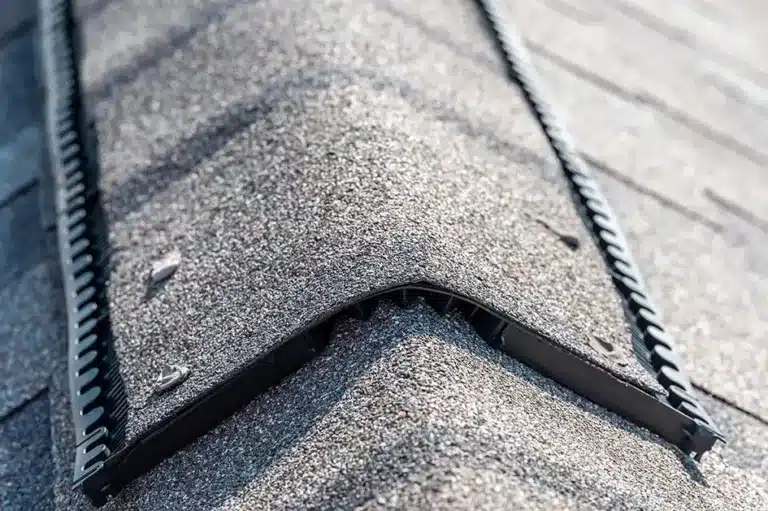
Ridge Vents (Exhaust) — Run along the entire length of the roof peak, allowing hot air to escape at the highest point. A continuous ridge vent provides consistent exhaust across the full ridgeline and is the preferred solution for most new DFW residential installations. Aesthetically clean and highly effective when paired with adequate soffit intake.
Static Roof Vents (Exhaust) — Individual vent boxes installed on the roof surface at specific points. Effective when properly sized and spaced, and common on older DFW homes that predate widespread ridge vent use.
Turbine Vents (Exhaust) — The spinning metal turbines visible on many older DFW homes. Effective in windy conditions, inconsistent when wind isn't present. Bearings wear over time and can stop rotating entirely — a non-functioning turbine is effectively a blocked vent.
Power Attic Ventilators (Exhaust) — Electrically or solar-powered attic fans provide active, consistent exhaust regardless of wind conditions. Solar-powered fans are particularly well-suited to DFW because they run on the abundant Texas sun at zero operating cost. They're especially useful in homes where roof geometry limits passive ventilation capacity.
Attic ventilation is a standard part of every professional inspection we conduct. We check soffit vent condition and clearance, exhaust vent type and adequacy, intake-to-exhaust balance, attic interior conditions where accessible, and whether insulation is blocking rafter bays and limiting intake.
If we identify ventilation deficiencies, we explain exactly what we found, what the consequences are likely to be, and what the options are to correct the problem — from installing rafter baffles to clear blocked soffits, to adding exhaust vents, to installing a solar-powered attic fan for active supplementation.
We also incorporate ventilation corrections into every roof replacement we perform. A new roof installed on a home with inadequate ventilation will fail prematurely — and a contractor who doesn't address ventilation during a replacement isn't completing the job.
The numbers are straightforward. A properly ventilated DFW roof lasts 20 to 25 years. A poorly ventilated one often fails at 12 to 15 — a difference of $12,000 to $18,000 in replacement cost paid years earlier than necessary. Cooling cost reductions of 10 to 20 percent from correcting ventilation deficiencies add up to $300 to $600+ per year back in your pocket. And preventing mold and decking damage avoids remediation costs that can exceed the cost of the roof replacement itself.
Attic ventilation isn't glamorous. But in DFW's climate, it may be the single most cost-effective investment a homeowner can make in their roof's long-term performance.

Concerned about whether your DFW home's attic ventilation is protecting your roof — or quietly working against it?
At Timeless Roofing, every inspection includes a thorough assessment of your attic ventilation system. We'll tell you exactly what we find, what it means for your roof's lifespan and your energy bills, and what — if anything — needs to be done.
Schedule your free roof and ventilation inspection with Timeless Roofing today.

.svg)

.svg)
.svg)
.svg)